Dec 6, 2025 | Newspaper Clip
- Speakers said that women workers regularly face harassment, violence, and especially cyber abuse at the workplace
- They urged both factory owners and the state to take effective steps to stop these abuses
- “Having laws is not enough—there must be proper enforcement and a guarantee of workplace safety,” they said
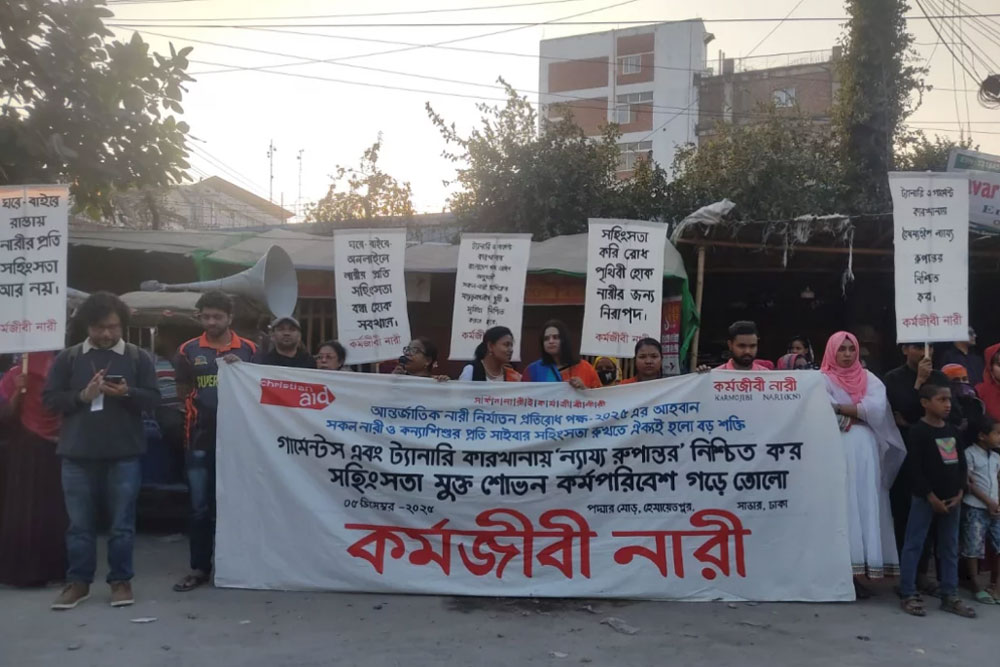
A human chain was formed at Hemayetpur Padma intersection in Savar, demanding an end to cyber violence and ensuring a worker-friendly environment for women workers. Karmojibi Nari organized the human chain programme on Friday, marking International Day for the Elimination of Violence Against Women.
More than a hundred women workers from garment units, tanneries, and other factories joined the programme.
The human chain was chaired by project coordinator Hasina Akter Nainu, while project coordinator Rajib Ahmed conducted the event.
Speakers said that women workers regularly face harassment, violence, and especially cyber abuse at the workplace. They urged both factory owners and the state to take effective steps to stop these abuses. “Having laws is not enough—there must be proper enforcement and a guarantee of workplace safety,” they said.
Speakers included Sheikh Shahnaz, General Secretary of the Garments and Industrial Workers Alliance; Al-Zahid, Project Officer of Karmojibi Nari; Rabeya Akter, Chair of the NCCWE Women’s Committee; and Nargis Akter, General Secretary of Darus Salam Thana National Workers Alliance.
They expressed hope that increased awareness and improved working conditions will boost women workers’ productivity and positively impact the industrial sector.
News Link: dhakatribune.com
Sep 9, 2025 | Newspaper Clip
Speakers at an event yesterday urged the government to amend the Bangladesh Labour Act 2006 to recognise domestic, home-based, transport, waste and other informal workers, who make up 85 percent of the country’s workforce.
They also called on political parties to prioritise the rights and welfare of informal sector workers in the upcoming national elections. Google News LinkFor all latest news, follow The Daily Star’s Google News channel.
The demands were made at a consultation titled “National Consultation: Study Findings on Dynamic Mapping of Informal Sector Workers in Bangladesh”, organised by Karmojibi Nari at The Daily Star Centre in the capital.
Speaking as chief guest, Syed Sultan Uddin Ahmed, executive director of the Bangladesh Institute of Labour Studies (BILS), stressed the need to build a comprehensive database of informal sector workers, ensure job security, provide skill development opportunities, and allow workers to report grievances to the Department of Inspection for Factories and Establishments.
He emphasised promoting organisation and unionisation and urged political parties to include informal workers’ agendas in their election manifestos.
Hafiza Begum, a researcher at Adhuna Bangladesh Limited, presented the study “Mapping of Informal Sector Workers in Bangladesh: Challenges, Opportunities and Policy Implications” at the event.
The study found that informal work dominates the labour market, accounting for 85 percent of the workforce across nearly 450 occupations.
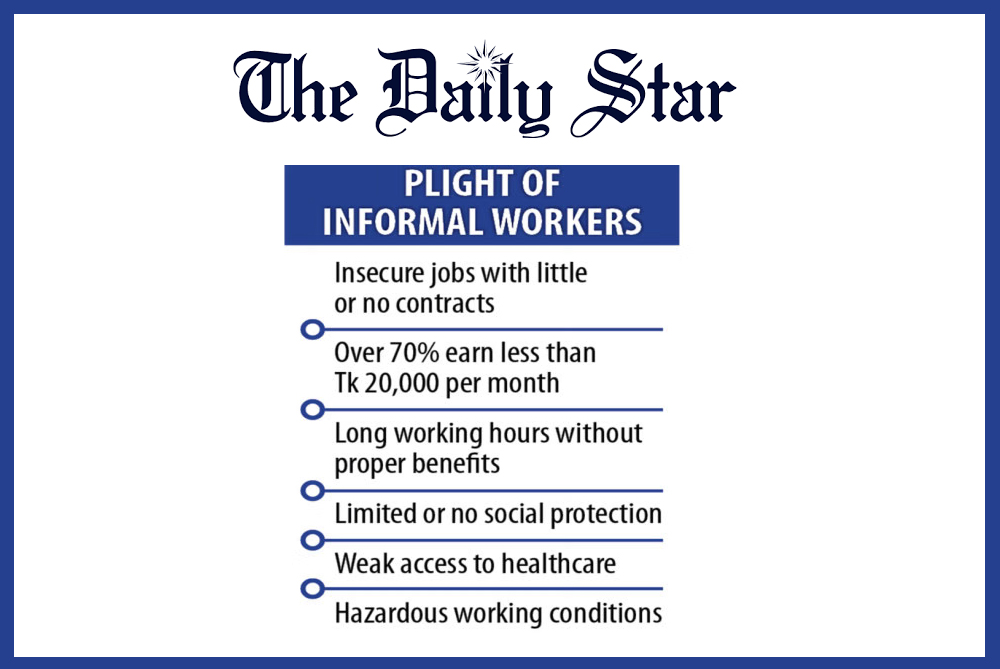
Workers face insecure jobs, long hours, low and unstable incomes, limited social protection and hazardous conditions, with women and children especially vulnerable.
Despite policy recognition and initiatives such as the National Social Security Strategy, targeted insurance schemes, skill development programmes, and support from the Ministry of Labour and Employment, Social Welfare, NSDA, PKSF, SME Foundation and the Universal Pension Authority, gaps in coordination, weak enforcement and low awareness have limited effectiveness, said the study.
It revealed that most informal workers earn modest incomes, with more than 70 percent making less than Tk 20,000 per month, while household expenditures generally range between Tk 10,000 and 19,000, leaving little room for savings.
As a result, 69 percent save Tk 1,000 or less per month, showing low financial resilience and vulnerability to economic shocks, alongside the urgent need for targeted social protection and financial inclusion.
Awareness and participation in skill programmes are also poor, with only 19.3 percent aware of such opportunities and 1.6 percent having participated, although 44.7 percent expressed interest in training.
Access to finance relies mostly on informal sources such as local associations (40.4 percent) and individuals (27 percent), while formal institutions play a minor role. Workers identified financial grants (49.5 percent), low-interest loans (30.7 percent) and skill development (11.6 percent) as key requirements for business growth.
The study also showed limited awareness of social protection schemes, with 87 percent of respondents unaware of the Universal Pension Scheme, highlighting the need for information campaigns and capacity-building.
It recommended recognising informal workers in labour laws, ratifying key ILO conventions and updating policies to address gender, age, disability and migration. It also called for better institutional coordination through a permanent Labour Commission, labour market mapping and a digital labour registry.
Other recommendations included strengthening worker representation, supporting unionisation and ensuring participation in policymaking.
At the event, Parul, an informal sector worker from Rajshahi, shared her struggles.
She said she survived by selling snacks near schools, going around villages with turmeric, chilli and dried fish, helping patients in hospitals, and even doing welding work.
She said if she had been included in any social welfare programme, she could have lived her later years with greater security and dignity.
The consultation was chaired by Umme Hasan Jhalmal, vice president of Karmojibi Nari and joint coordinator of Nari Shramik Kantha.
Special guests included Dr Felix Gerdes, resident representative of FES Bangladesh, and Dr Mohammed Hossain Sarkar, joint secretary of the Ministry of Labour and Employment.
Mustafiz Ahmed, associate professor at the Department of Social Work at Jagannath University; Rajekuzzaman Ratan, president of the Samajtantrik Shramik Front; and Ruman Ishtiaq, national project coordinator (formalisation project) of the ILO, also spoke, among others.
Sanjida Sultana, additional executive director of Karmojibi Nari, moderated the event.
Source Link: The Daily Star
Sep 8, 2025 | Newspaper Clip
About 450 occupations in Bangladesh’s informal sector have been identified, with most workers found to be engaged in retail and sales, followed by agriculture and livestock, food and beverage services, transport, and crafts, according to a joint study.
The study, titled “Mapping of Informal Sector Workers in Bangladesh: Challenges, Opportunities, and Policy Implications,” surveyed 768 informal sector workers across all divisions of the country.
Conducted jointly by Karmojibi Nari and FES Bangladesh, the study found that the majority of informal workers (69 per cent) are between the ages of 25 and 44.
Most informal workers—73.3 per cent—are self-employed or run small businesses, while 21.7 per cent are employed on a contractual basis. Only a small portion is engaged in regular or family-based work.
Hafiza Begum, lead researcher at Adhuna Bangladesh Limited, presented the findings at a programme held in Dhaka on Monday.
The study highlighted key challenges facing informal workers, including the absence of guaranteed income, exposure to health risks, unsafe working conditions, and a lack of access to social security. Despite accounting for nearly 85 per cent of the country’s total workforce, informal workers are deprived of legal recognition, leaving them vulnerable to exploitation, disrespect, and harassment.
Income instability caused by seasonal employment and daily wage fluctuations is particularly acute in agriculture and street vending, the report said. It also noted that access to formal financial services remains limited, forcing workers to rely on informal loans and community savings.
Speaking at the event, Syed Sultan Uddin Ahmed, executive director of the Bangladesh Institute of Labour Studies (BILS), underscored the need to develop a database of informal workers to ensure social protection.
He stressed that formalisation of both enterprises and employment should proceed simultaneously, cautioning that formalising enterprises alone could create new problems. He further emphasised the importance of identifying risks within the informal sector, safeguarding citizens’ basic rights, and ensuring that workers’ demands are reflected in the election manifestos of candidates.
Mr Ahmed, a former chairman of the Labour Reform Commission, also recommended establishing a grievance mechanism to allow workers to lodge complaints.
Saifuzzaman Badsha, president of Jatiyo Sramik Jote Bangladesh, called for setting a national minimum wage for all workers and bringing the country’s 73 million informal workers under the provisions of the labour law by formally recognising them.
Speakers also urged the government to clearly define informal sector workers, extend legal recognition, create formal employment opportunities, ratify ILO Conventions 177, 188, 189, and 190, and implement ILO Recommendation 204 to facilitate the transition of workers from informal to formal employment.
FES Bangladesh resident representative Felix Gerdes; Department of Women Affairs director; Karmojibi Nari additional executive director Sunzida Sultana; and its vice president Umme Hassan Jholmol, among others, also spoke at the event.
Source Link: The Financial Express
Sep 8, 2025 | Newspaper Clip
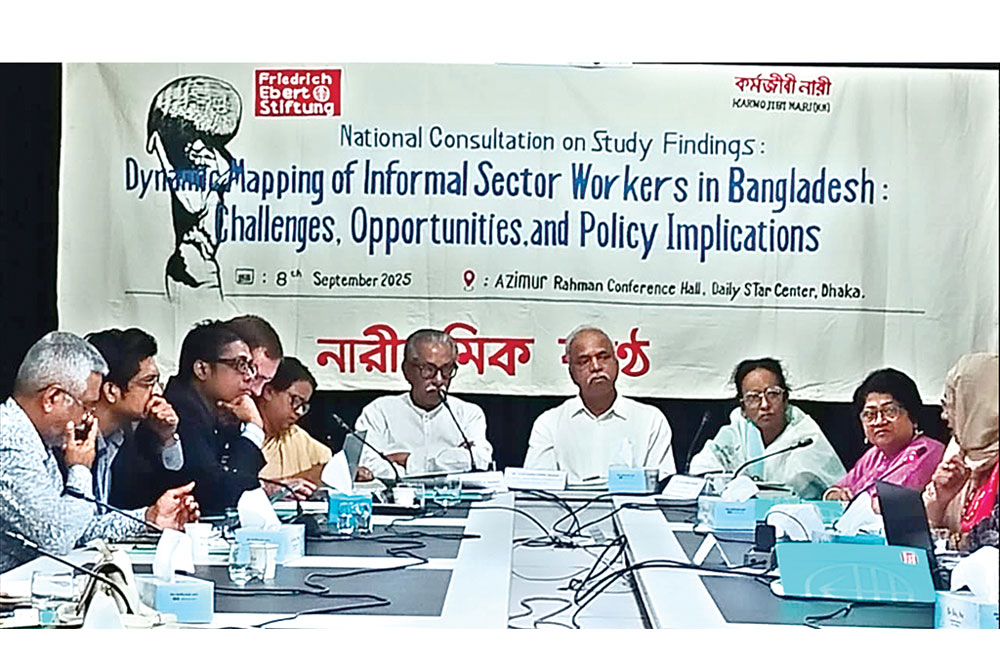
Karmojibi Nari organises a discussion on the findings of a study, titled ‘Mapping of Informal Sector Workers in Bangladesh: Challenges, Opportunities and Policy Implications’, at the Daily Star Centre in Dhaka on Monday. | Press release
Trade union leaders and labour rights activists on Monday urged the government to ensure labour rights and protection for informal sector workers, who make up the majority of Bangladesh’s workforce but remain outside the scope of the labour law.
They said that informal workers, lacking legal recognition, written contracts, or income security, were more vulnerable to exploitation and lived in precarious conditions.
The call came at a discussion organised by non-government organisation Karmojibi Nari at The Daily Star Centre in Dhaka, where findings of a study titled ‘Mapping of Informal Sector Workers in Bangladesh: Challenges, Opportunities and Policy Implications’ were shared.
The study, conducted with support from Friedrich Ebert Stiftung, surveyed 768 informal workers across the country between September and November 2024. It identified about 450 different occupations in the informal economy, where workers often toil up to 12 hours a day without any formal protection.
According to the findings, 69 per cent of workers were aged between 25 and 44, with the largest share — 7.7 per cent — working as street vendors.
Labour Reform Commission chairman and Bangladesh Institute of Labour Studies executive director Syed Sultan Uddin Ahmed urged the government to build a national data hub on informal workers and bring them under social protection.
‘Announcement of a national minimum wage can be one initiative to ensure better wages,’ he said.
Samajtantrik Sramik Front president Razekuzzaman Ratan said informal sector workers faced greater exploitation than formal workers due to their vulnerability.
Jagannath University associate professor of social work Mostafiz Ahmed observed that child labour was likely higher in the informal sector, yet no dispute resolution mechanism existed there.
ILO Formalisation project coordinator Ruman Ishtiak said formalising payment systems could offer workers protection and recognition.
Jatiya Sramik Jote Bangladesh president Saifuzzaman Badsha stressed that rights and protection could not be ensured without legal recognition of informal workers.
Speakers pointed out that over 85 per cent of Bangladesh’s total workforce was engaged in the informal economy, yet the government had no comprehensive protection measures for them.
Julia Jesmin, joint inspector general of the Department of Inspection for Factories and Establishments, acknowledged that the current labour law did not cover informal workers.
Other trade union leaders, rights activists, and government officials also spoke at the event.
Source Link: New Age
Dec 10, 2024 | Newspaper Clip
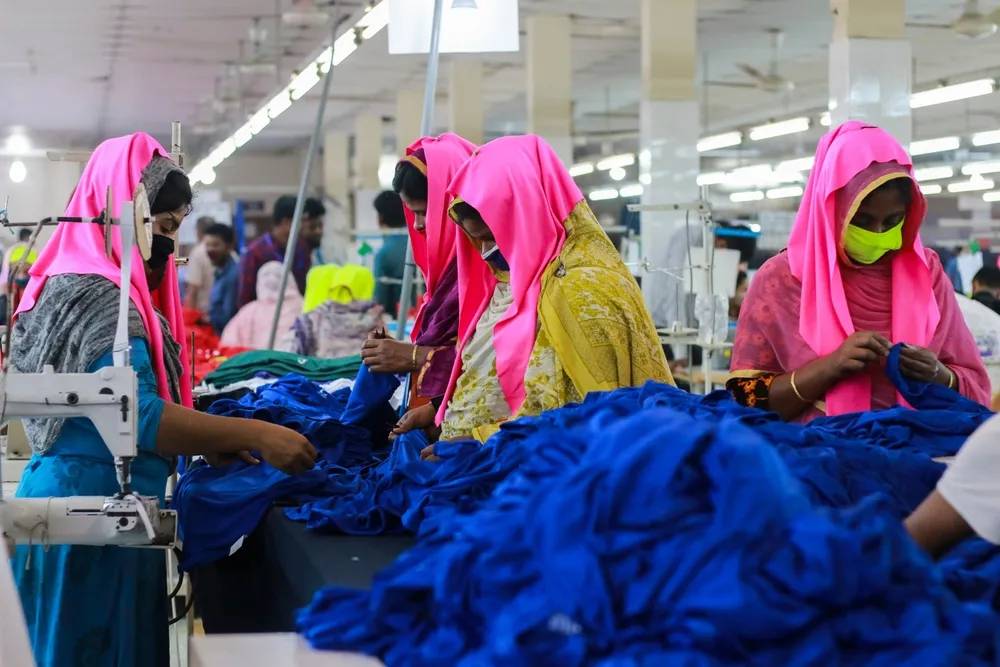
”On Human Rights Day, what needs to happen to protect Bangladesh’s garment workers?”
Karmojibi Nari (KN) and Bangladesh Center for Workers Solidarity (BCWS) jointly wrote a blog on Just Transition in the RMG Industry in Bangladesh in honor of Human Rights Day 2024 and it was published on the Business & Human Rights Resource Centre (BHRRC) website.
Link: Click for Details News
May 1, 2024 | Newspaper Clip
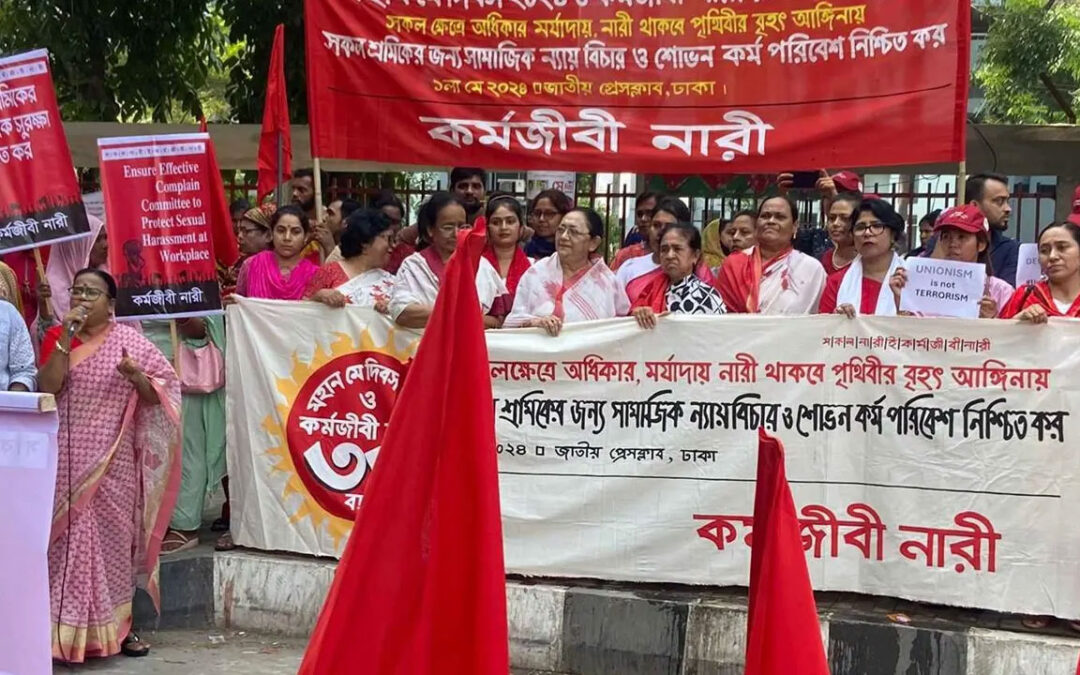
‘সকল ক্ষেত্রে অধিকার মর্যাদায়, নারী থাকবে পৃথিবীর বৃহৎ আঙিনা’- এই স্লোগানকে সামনে রেখে এবং ‘সকল শ্রমিকের জন্য সামাজিক ন্যায়বিচার ও শোভন কর্মপরিবেশ নিশ্চিত করো’- এই প্রতিপাদ্য নিয়ে মহান মে দিবস ও কর্মজীবী নারীর ৩৩তম প্রতিষ্ঠাবার্ষিকী উদযাপন উপলক্ষে জাতীয় প্রেস ক্লাব চত্বরে শ্রমিক সমাবেশ ও লাল পতাকা মিছিল অনুষ্ঠিত হয়েছে।
কর্মজীবী নারীর সহসভাপতি উম্মে হাসান ঝলমলের সভাপতিত্বে এবং অতিরিক্ত নির্বাহী পরিচালন সানজিদা সুলতানার সঞ্চালনায় প্রধান অতিথি হিসেবে বক্তব্য দেন কর্মজীবী নারীর প্রতিষ্ঠাতা সভাপতি শিরীন আখতার।
আরও বক্তব্য দেন দক্ষিণ এশিয়াভিত্তিক নারীবাদী সংগঠন এশিয়া প্যাসিফিক ফোরাম অন উইমেন, ল অ্যান্ড ডেভেলপমেন্ট (এপিডব্লিউএলডি) এর ৮টি দেশ (ভারত, কম্বোডিয়া, ইন্দোনেশিয়া, থাইল্যান্ড, মালয়শিয়া, দক্ষিণ কোরিয়া, ফিলিপাইন এবং বাংলাদেশ) এর প্রতিনিধিরা, কর্মজীবী নারীর সহসভাপতি ও ট্রেড ইউনিয়ন নেত্রী শাহীন আক্তার পারভীন, শ্রমিক নেত্রী রাবেয়া আক্তার, শেখ শাহনাজ, নার্গিস আক্তার এবং জাকিয়া সুলতানা প্রমুখ।
সমাবেশের প্রধান অতিথি শিরীন আখতার বলেন, আমাদের সবাইকে মনে-প্রাণে বিশ্বাস করতে হবে, শ্রম কখনো সস্তা নয়, শ্রমিক দয়ার পাত্র নয়। আমরা নারীরা এখনো কর্মক্ষেত্রে সমমজুরি, সমমর্যাদা এবং কর্তৃত্ব তৈরি করতে পারিনি। এজন্য আমাদের এখনো বহুদূর যেতে হবে। নারীশ্রমিকদের অর্থনৈতিক ক্ষমতায়নে তাদের কর্মের ধারাবাহিকতা রক্ষায় কর্মক্ষেত্রে মানসম্মত এবং কার্যকর শিশু দিবাযত্ন কেন্দ্র প্রতিষ্ঠা করতে হবে।
দক্ষিণ এশিয়াভিত্তিক নারীবাদী সংগঠন এশিয়া প্যাসিফিক ফোরাম অন উইমেন, ল অ্যান্ড ডেভেলপমেন্ট (এপিডব্লিউএলডি)-এর প্রোগ্রাম অফিসার অ্যান্ডি কিপ্টা, ইন্দোনেশিয়ান ট্রেড ইউনিয়ন নেতা এ্মিলিয়া ইয়ান্তি, কর্মজীবী নারীর শ্রমিক সমাবেশের উত্থাপিত দাবিসমূহের সঙ্গে সংহতি প্রকাশ করে বলেন, সব বৈষম্য দূর করে নারী শ্রমিকের জন্য সামাজিক ন্যয়বিচার ও শোভন কর্মপরিবেশ নিশ্চিত করা প্রয়োজন।
মিরপুর অঞ্চলের গৃহশ্রমিক অধিকার প্রতিষ্ঠা আঞ্চলিক ফোরাম এর নেত্রী জাকিয়া সুলতানা, গৃহশ্রমিকদের কাজের কোনো নির্দিষ্ট কর্মঘণ্টা এবং মাতৃত্বকালীন ছুটি শ্রম আইনে অন্তর্ভুক্ত করার দাবি জানান।
সভাপতিরর বক্তব্যে উম্মে হাসান ঝলমল বলেন, কর্মক্ষেত্রে নারী শ্রমিকরা প্রতিনিয়ত বৈষম্যের শিকার হয়ে থাকে। এসব বৈষম্য দূরীকরণে আইনের সঠিক প্রয়োগ করতে হবে। যেখানে শ্রমিকের ন্যায্য অধিকার নিয়ে কার্পণ্য করা হবে, সেখানেই সংগঠিত হয়ে অধিকার আদায় করতে হবে।
সমাবেশ শেষে একটি বর্ণাঢ্য লাল পতাকা মিছিল প্রেস ক্লাব থেকে পল্টন মোড় প্রদক্ষিণ করেন।
News Link: kalbela